Transinterpreters and Pemintechs: The New Professions Are Already Here

By Claudia Brauer

Ask language professionals how the field feels right now and many will say: shrinking. Look at what the market is actually doing, and a different picture emerges. The work is not disappearing — it is reorganizing into new professions, with new names, because the old job descriptions no longer match how assignments arrive. In my course “New professions for 2025” I teach two of these profiles in detail. Here they are, precisely defined, with the skills each requires — because most language professionals have not heard these definitions yet, and they describe jobs that already exist.
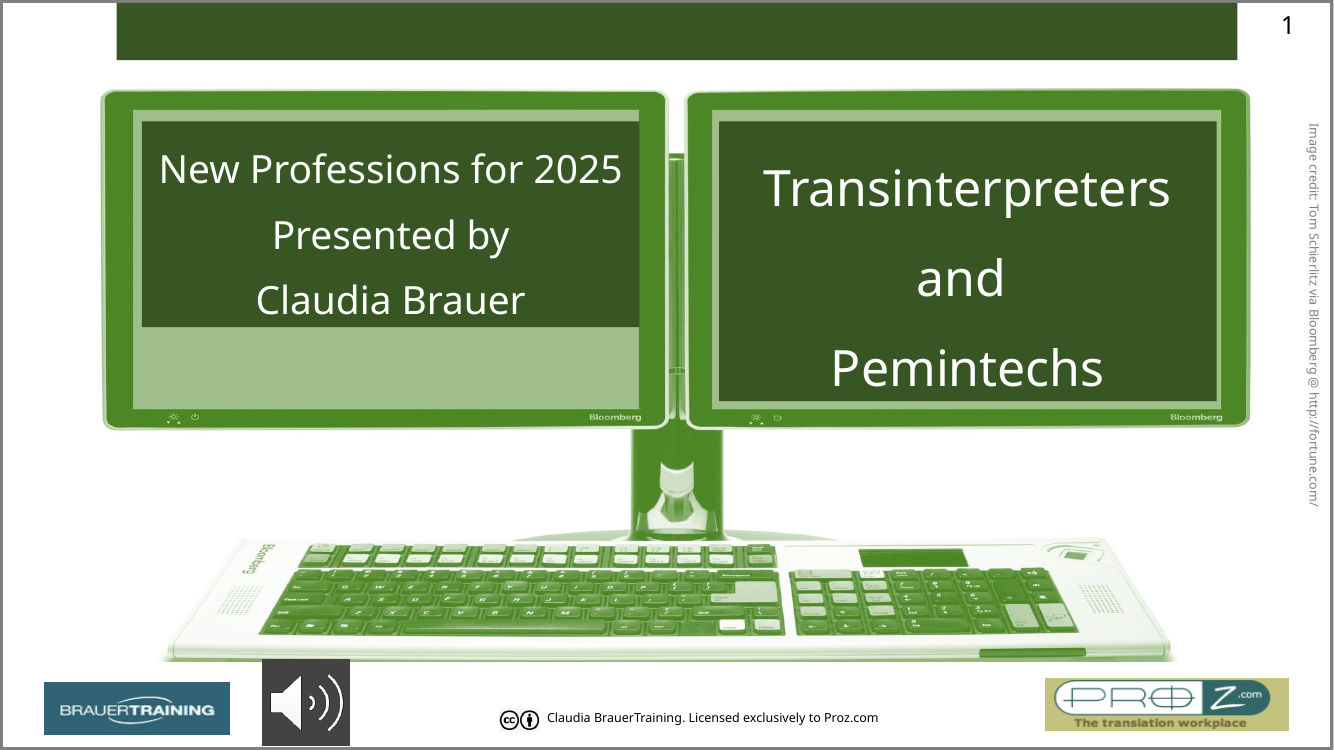
From the course slides: 'New Professions for 2025 — Transinterpreters and Pemintechs.'
From the course slides: ‘New Professions for 2025 — Transinterpreters and Pemintechs.’

The reset: changing times, changing needs. For most of the twentieth century, the language professions were divided by a clean line: you were a translator or an interpreter. Separate training, separate associations, separate careers. The twenty-first century erased that line. The same client, the same project, now produces documents to translate, machine output to post-edit, and meetings to interpret — often in the same week. As I put it in the course: we cannot change what we don’t acknowledge. The first step is admitting the old identity no longer fits. The second is building the new one deliberately.

The transinterpreter. A transinterpreter is a linguist who works as both a translator and an interpreter — at the same time, as one integrated professional offer. This is not a translator who occasionally helps out with a phone call. It is a professional trained in both crafts: written translation, consecutive interpreting, and simultaneous interpreting, including the hybrid mode known as sim-consec, and able to deliver in person, over the phone (OPI), by video remote (VRI), and through web-based platforms. Clients increasingly buy outcomes, not categories. The professional who can cover both sides of an assignment is simply more valuable than two half-available specialists — and harder to replace.
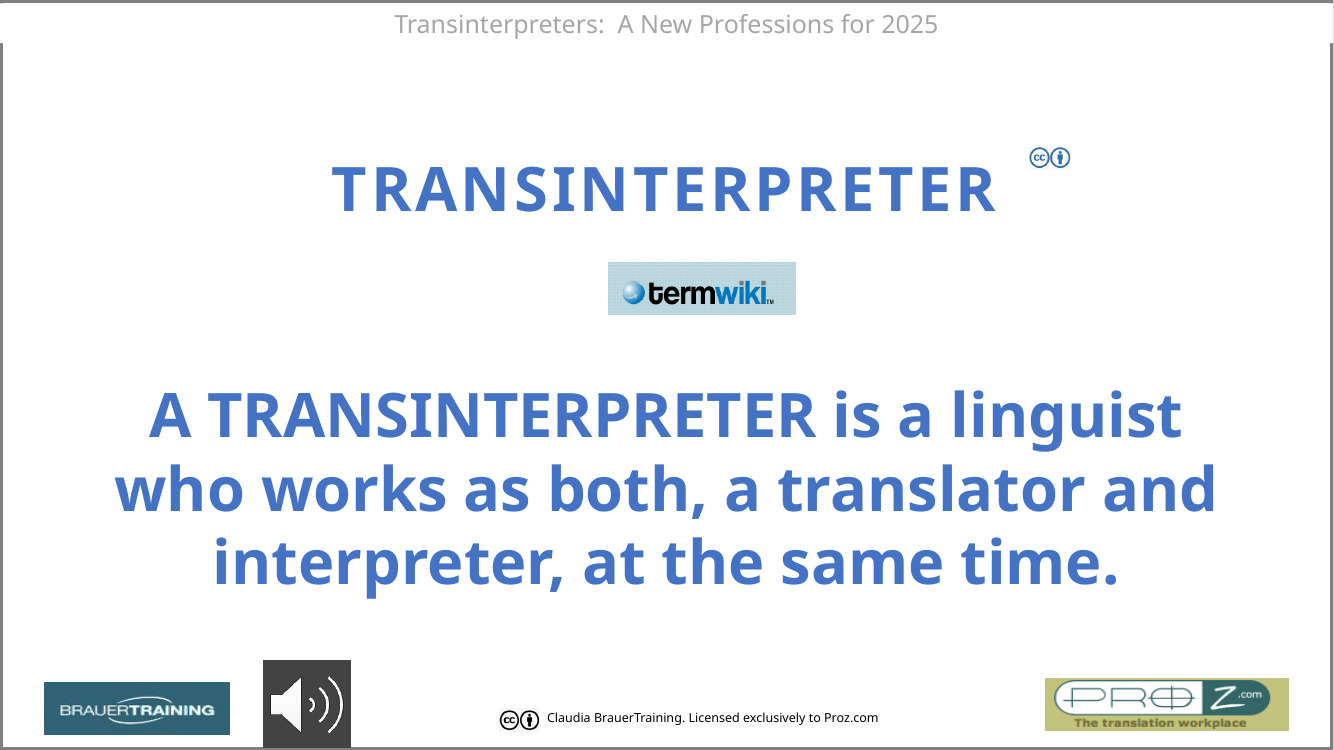
From the course slides: the transinterpreter, defined.

The pemintech. A pemintech is a post-editor of machine and AI translation who is also an interpreter, and who is savvy in the use of technology. Unpack the name: PEM — post-editor of machine translation; INT — interpreter; TECH — technologically fluent. The pemintech’s skill set forms a wheel: post-editing MT and AI output, simultaneous interpreting, consecutive interpreting, transinterpreting, computer literacy, digital technologies, artificial intelligence, and advanced soft skills. This profile exists because of how work actually arrives now: a machine-translated document in the morning, a video meeting to interpret after lunch, terminology to control throughout. One professional, built for that mixture.

Why new professions appear at all. Electricians did not exist before electricity. Professions are born “in response to” radical changes in how humans communicate and work — and machine translation plus remote interpreting is exactly such a change. Transinterpreters and pemintechs are not marketing labels. They are the labor market’s answer to a new technical reality, the same way electricity created the electrician.
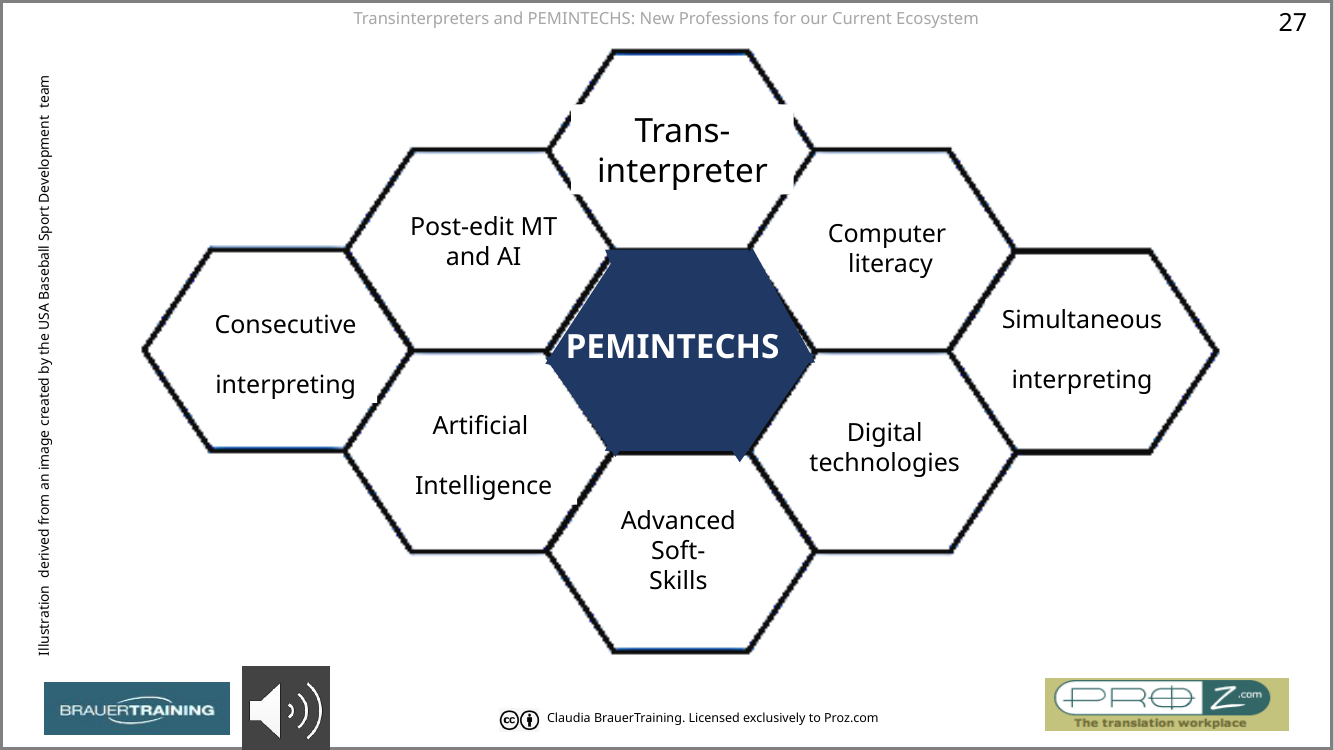
From the course slides: the pemintech skill set.

What “tech-savvy” concretely means. Not a vague comfort with computers — a checklist. A proficient user of desktop and laptop computers, tablets, and modern phone systems. Fluent in the office suite and in OCR software. At home on the video-remote interpreting platforms clients actually use — KUDO, Interprefy, Voiceboxer, Interactio, Zoom, Microsoft Teams, Boostlingo, and others. A proficient user of CAT tools and translation memories, and of machine translation itself, understanding that engines differ and output varies. Knowledgeable in business software such as accounting and invoicing, and aware of project-management tools. That is the floor, not the ceiling.

And the soft skills are not optional. Technical skill alone is no longer enough. The new profiles require the ability to change gears, emotional intelligence, teamwork, work ethic, and communication skills. The beginner set: problem-solving, critical thinking, passion, curiosity, flexibility, commitment, persistence, creativity, imagination. The advanced set: attention to detail, time management, writing proficiency, media literacy, initiative, leadership, collaboration, productivity, and social skills. Knowledge versus skills is the distinction that matters — knowing about the work is theory; the market pays for people who can do it.

A self-audit: which one are you becoming? Read the two definitions again as a mirror. If you translate well but have never trained in interpreting technique — no consecutive, no simultaneous — the transinterpreter path starts there, with the interpreting half of the craft. If you already move between written and spoken work but machine translation post-editing is your gap, that is the pemintech path, and it starts with post-editing practice and technology. And if technology itself is the weak leg, the checklist above tells you where to begin. The point of the audit is honesty: the market will not wait for any of us to feel ready, but it rewards professionals who close their real gaps instead of polishing their existing strengths.

The wider map — and where to start. The course also maps income honestly. The established sources of income — translator, transcreator, localization expert, interpreter, posteditor — now stand joined by two new lines: transinterpreter and pemintech. The task is to add the new lines deliberately, alongside the work that already pays — not to abandon proven income on a promise.

These two profiles sit inside a much larger family of new language careers: localization expert, transcreator, project manager, research linguist, subtitler, voice actor, terminologist, LQA tester, SEO specialist, content writer, language trainer, language technologist, language consultant, language lead. Underneath all of them runs the shift Nimdzi Insights describes: from translator to trusted advisor, the professional clients call for expertise, cultural insight, and judgment. As translator Valerie Anger recently wrote, the real question is not whether we still need humans, but where human expertise, judgment, and accountability are indispensable. In the course I close with a survival list for the next five years: become tech-savvy, specialize, practice adaptability, grow your emotional intelligence, stay updated, keep learning, provide MTPE, use AI-powered tools, collaborate with AI — and deliver quality, every time. You do not need to learn it all at once. You need to develop skills, one at a time — starting with the profile closest to the work you already do, and then practicing. Practice, practice, practice: that is how a new profession becomes your profession.


My course “New professions for 2025: Transinterpreters and pemintechs,” presented for ProZ, walks through both profiles: the key issues driving the shift, the skill sets each profile requires — interpreting, post-editing, technology, soft skills — and practical tools to prepare your growth plan, so you can adapt to the evolving marketplace deliberately, before the demand peaks, and stay ready for the challenges of a fast-moving world instead of reacting to them. Both professions are within reach of working translators and interpreters today — this course shows the route, step by step.

Take the course: New professions for 2025: Transinterpreters and pemintechs — https://www.proz.com/next/learn/course/354

Sources: Nimdzi Insights, “Translators’ Role Evolves in AI-Driven Localization” — https://lnkd.in/p/eayb-7fY · Lionbridge, “AI Content Creation for Global Retail Giant” — https://lnkd.in/p/eFP5T7GC · Valerie Anger, LinkedIn post — https://lnkd.in/p/eNPySBrN

Becoming a Certified MT Posteditor: The Training Behind the Title

By Claudia Brauer

Machine translation is no longer something translators can choose to work around. Clients ask for it by name, agencies build their workflows on it, and the professional question has changed. It is no longer whether you will post-edit, but whether you will post-edit well — at the level each text actually needs, at a speed that makes the work profitable, and to a standard you can prove. Here is the working knowledge behind that standard, drawn from my Certified MT Posteditor training.

From the course slides: 'Present and Future of MT Postediting — Essential Facts.'
From the course slides: ‘Present and Future of MT Postediting — Essential Facts.’

First, know what post-editing is — and what it is not. Translation studies scholar Sharon O’Brien defines post-editing as a distinct form of translation revision: the posteditor refines texts that a machine generated automatically. That distinction matters in practice. You are not translating from zero, and you are not proofreading a colleague’s work. You are revising machine output with a trained eye for the specific ways machines fail — fluent sentences that say the wrong thing, correct grammar wrapped around the wrong term, numbers and names quietly altered. Post-editing sits inside a human-in-the-loop model: the machine contributes speed, the human contributes judgment, and neither half works properly without the other.

Second, match the edit to the purpose — there are three levels, not one. Light post-editing produces output that is understandable and acceptable. It is for information: the reader needs to grasp the content accurately, and nobody will publish it as polished prose. Intermediate post-editing adds enhanced readability and clarity while keeping a fast turnaround — the text reads well, not just correctly. Full post-editing produces an accurate translation equal to human translation in all aspects, fit to publish under your name. Confusing these levels is where posteditors lose money and clients: delivering too little on a text that mattered, or polishing a text nobody needed polished. The first professional decision on any post-editing job is not linguistic. It is: what is this text for, and which level does that purpose require? Decide it before you touch a single sentence, and agree it with the client.

Third, judge the machine’s output before you agree to fix it. Not every MT output deserves post-editing. Part of professional practice is setting realistic prospects for the engine in front of you: a strong engine on a suitable text can double your speed; a weak engine on the wrong text produces output so flawed that honest post-editing takes longer than translating from scratch. Learn to see that in the first paragraphs, say so early, and price the job for what it truly is. Clients respect the posteditor who tells them the truth about output quality. They stop calling the one who silently struggles.

That judgment depends on knowing the flaws machine translation typically produces, because they repeat across engines and texts. Terminology that changes from one paragraph to the next, because the machine has no memory of your glossary. Words quietly omitted — and occasionally added. Word order carried over from the source language, grammatical in neither. Formality that swings between formal and informal address inside a single document. Segments left untranslated altogether, hiding inside otherwise fluent text. And the most dangerous flaw of all: smooth, confident sentences that are simply wrong. A trained posteditor scans for these patterns the way an experienced proofreader scans for typos — systematically, not hopefully. When you can name the flaw, you can fix it in seconds. When you can’t, you read the same sentence five times and still ship the error.

Fourth, avoid the twin traps: under-editing and over-editing. Under-editing leaves real errors standing — a wrong term, a shifted number, a meaning reversed — because the sentence sounded fluent. Over-editing is the quieter trap: rewriting what the machine already got right, chasing personal style preferences the brief never asked for. Every unnecessary change burns the productivity that justified using MT in the first place. Post-editing guidelines exist precisely to discipline the hand: correct what the level requires, leave what it doesn’t.

Fifth, when you can, pre-edit. Some of the worst post-editing problems were sitting in the source text before the machine ever saw it. Ambiguous sentences, broken formatting, inconsistent terminology in the original — the engine will faithfully multiply all of it. Cleaning the source first, when the workflow allows it, raises the quality of everything downstream. It is one of the least-used and most effective tools a posteditor has.

Sixth, finish with a real QA pass — and treat confidentiality as technique. Editing is not delivery. Before the file leaves your desk, run a dedicated quality-assurance pass, separate from the editing itself, against a short checklist. Numbers, units, currencies, and dates — machines alter these silently, and a single wrong figure can cost more than the whole translation. Names of people, companies, and products, spelled the client’s way, every time. Terminology consistency: the same source term rendered the same way throughout, matching the glossary you were given. Completeness: every source segment present in the target, nothing dropped, nothing duplicated. Formatting and tags intact, so the file opens cleanly in the client’s system. Checklist QA catches the errors that sentence-by-sentence editing cannot see, because it looks at the document whole — the way the reader will. And remember that MT tools are not neutral pipes. Running a client’s confidential text through a free public engine can breach the confidentiality you owe that client. Knowing where your text goes is as professional a skill as knowing how to fix it.

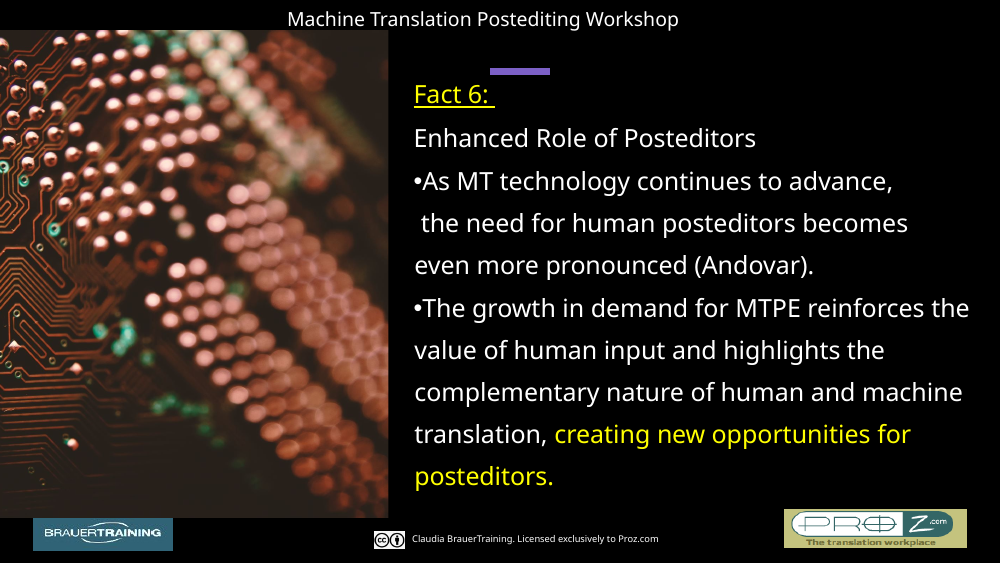
From the course slides: Fact 6 — the enhanced role of posteditors (Andovar).

Why this matters now. The market has already moved. Demand for translation keeps climbing, and an ever-larger share of that work now arrives as machine output waiting for a professional’s revision. Industry research projects post-editing to become a prominent trend in language services — and notes that as MT technology advances, the need for human posteditors becomes more pronounced, not less, because every improvement in the machines multiplies the volume of text that needs expert human judgment before it can be trusted. The opportunity is real. So is the standard. The professionals who thrive will be the ones who can do this work demonstrably well.

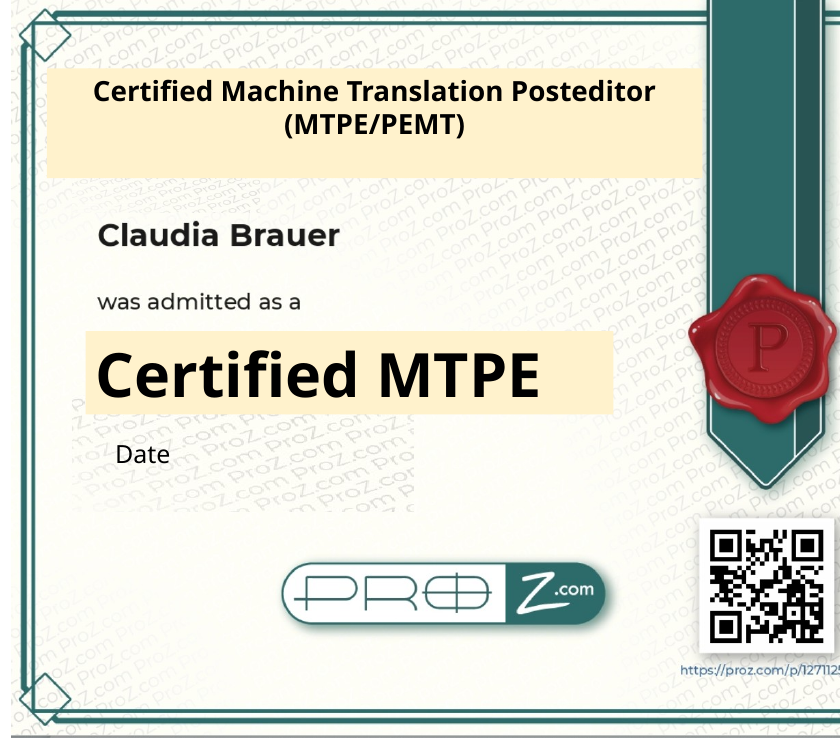
The certificate awarded on passing: Certified Machine Translation Posteditor (MTPE/PEMT).

The full training is self-paced (20 hours): on-demand videos and screen shares across seven-plus modules, hands-on exercises on real machine-translated texts of different quality levels, reading and research assignments, quizzes, and a four-part final test. Pass it, and you receive certification as a Machine Translation Posteditor, with the option to join the ProZ.com Certified MTPE Network — a proven, certified new line of business to offer your clients with confidence. Enrollment is open now, and the training fits around your client work.

Take the course: Certified MT posteditor training — https://www.proz.com/next/learn/course/202 (20 hours, $99; free for ProZ Plus and Premium members).