

By Claudia Brauer
Machine translation is no longer something translators can choose to work around. Clients ask for it by name, agencies build their workflows on it, and the professional question has changed. It is no longer whether you will post-edit, but whether you will post-edit well — at the level each text actually needs, at a speed that makes the work profitable, and to a standard you can prove. Here is the working knowledge behind that standard, drawn from my Certified MT Posteditor training.
First, know what post-editing is — and what it is not. Translation studies scholar Sharon O’Brien defines post-editing as a distinct form of translation revision: the posteditor refines texts that a machine generated automatically. That distinction matters in practice. You are not translating from zero, and you are not proofreading a colleague’s work. You are revising machine output with a trained eye for the specific ways machines fail — fluent sentences that say the wrong thing, correct grammar wrapped around the wrong term, numbers and names quietly altered. Post-editing sits inside a human-in-the-loop model: the machine contributes speed, the human contributes judgment, and neither half works properly without the other.
Second, match the edit to the purpose — there are three levels, not one. Light post-editing produces output that is understandable and acceptable. It is for information: the reader needs to grasp the content accurately, and nobody will publish it as polished prose. Intermediate post-editing adds enhanced readability and clarity while keeping a fast turnaround — the text reads well, not just correctly. Full post-editing produces an accurate translation equal to human translation in all aspects, fit to publish under your name. Confusing these levels is where posteditors lose money and clients: delivering too little on a text that mattered, or polishing a text nobody needed polished. The first professional decision on any post-editing job is not linguistic. It is: what is this text for, and which level does that purpose require? Decide it before you touch a single sentence, and agree it with the client.
Third, judge the machine’s output before you agree to fix it. Not every MT output deserves post-editing. Part of professional practice is setting realistic prospects for the engine in front of you: a strong engine on a suitable text can double your speed; a weak engine on the wrong text produces output so flawed that honest post-editing takes longer than translating from scratch. Learn to see that in the first paragraphs, say so early, and price the job for what it truly is. Clients respect the posteditor who tells them the truth about output quality. They stop calling the one who silently struggles.
That judgment depends on knowing the flaws machine translation typically produces, because they repeat across engines and texts. Terminology that changes from one paragraph to the next, because the machine has no memory of your glossary. Words quietly omitted — and occasionally added. Word order carried over from the source language, grammatical in neither. Formality that swings between formal and informal address inside a single document. Segments left untranslated altogether, hiding inside otherwise fluent text. And the most dangerous flaw of all: smooth, confident sentences that are simply wrong. A trained posteditor scans for these patterns the way an experienced proofreader scans for typos — systematically, not hopefully. When you can name the flaw, you can fix it in seconds. When you can’t, you read the same sentence five times and still ship the error.
Fourth, avoid the twin traps: under-editing and over-editing. Under-editing leaves real errors standing — a wrong term, a shifted number, a meaning reversed — because the sentence sounded fluent. Over-editing is the quieter trap: rewriting what the machine already got right, chasing personal style preferences the brief never asked for. Every unnecessary change burns the productivity that justified using MT in the first place. Post-editing guidelines exist precisely to discipline the hand: correct what the level requires, leave what it doesn’t.
Fifth, when you can, pre-edit. Some of the worst post-editing problems were sitting in the source text before the machine ever saw it. Ambiguous sentences, broken formatting, inconsistent terminology in the original — the engine will faithfully multiply all of it. Cleaning the source first, when the workflow allows it, raises the quality of everything downstream. It is one of the least-used and most effective tools a posteditor has.
Sixth, finish with a real QA pass — and treat confidentiality as technique. Editing is not delivery. Before the file leaves your desk, run a dedicated quality-assurance pass, separate from the editing itself, against a short checklist. Numbers, units, currencies, and dates — machines alter these silently, and a single wrong figure can cost more than the whole translation. Names of people, companies, and products, spelled the client’s way, every time. Terminology consistency: the same source term rendered the same way throughout, matching the glossary you were given. Completeness: every source segment present in the target, nothing dropped, nothing duplicated. Formatting and tags intact, so the file opens cleanly in the client’s system. Checklist QA catches the errors that sentence-by-sentence editing cannot see, because it looks at the document whole — the way the reader will. And remember that MT tools are not neutral pipes. Running a client’s confidential text through a free public engine can breach the confidentiality you owe that client. Knowing where your text goes is as professional a skill as knowing how to fix it.
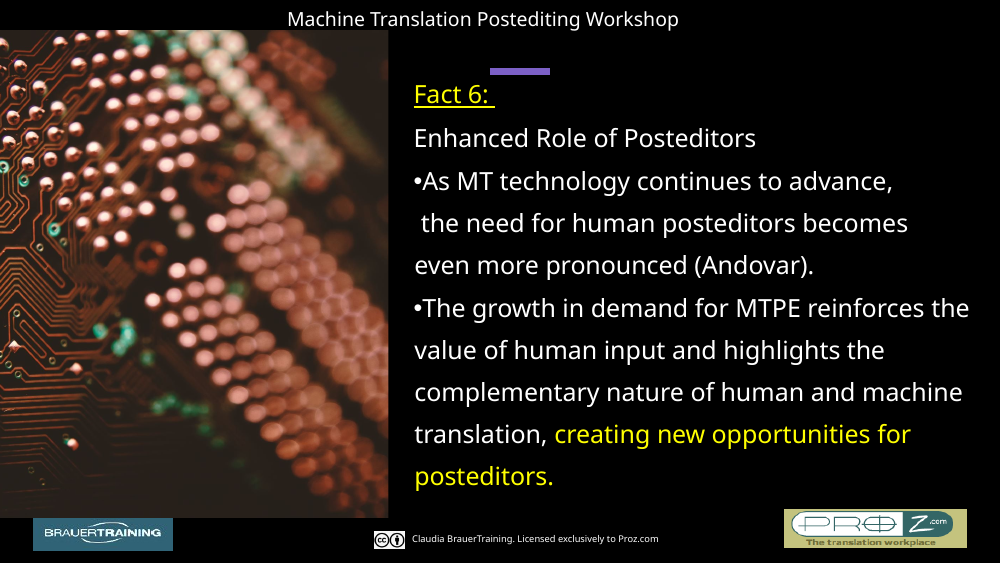
Why this matters now. The market has already moved. Demand for translation keeps climbing, and an ever-larger share of that work now arrives as machine output waiting for a professional’s revision. Industry research projects post-editing to become a prominent trend in language services — and notes that as MT technology advances, the need for human posteditors becomes more pronounced, not less, because every improvement in the machines multiplies the volume of text that needs expert human judgment before it can be trusted. The opportunity is real. So is the standard. The professionals who thrive will be the ones who can do this work demonstrably well.
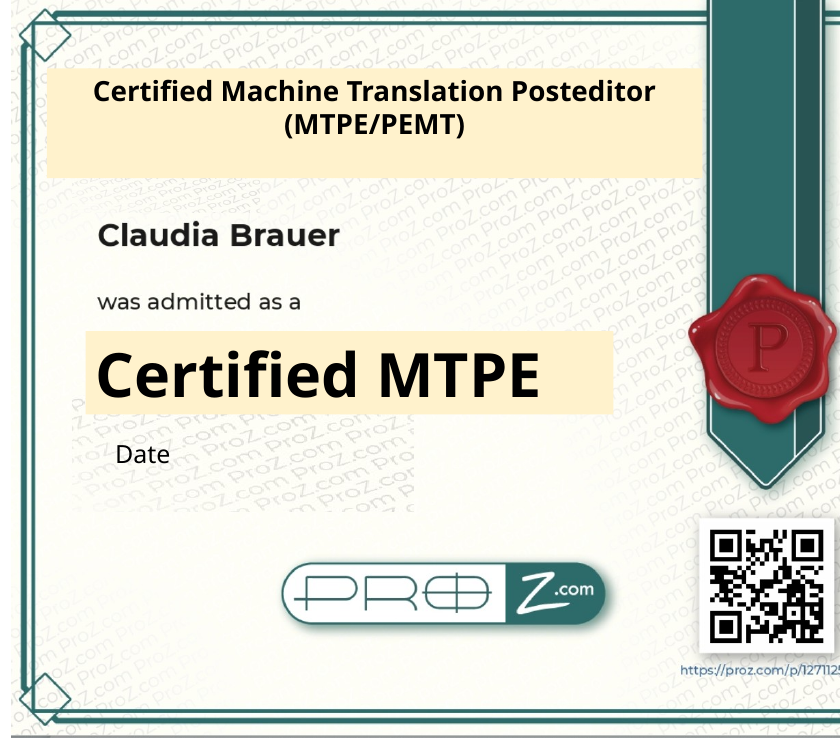
The full training is self-paced (20 hours): on-demand videos and screen shares across seven-plus modules, hands-on exercises on real machine-translated texts of different quality levels, reading and research assignments, quizzes, and a four-part final test. Pass it, and you receive certification as a Machine Translation Posteditor, with the option to join the ProZ.com Certified MTPE Network — a proven, certified new line of business to offer your clients with confidence. Enrollment is open now, and the training fits around your client work.
Take the course: Certified MT posteditor training — https://www.proz.com/next/learn/course/202 (20 hours, $99; free for ProZ Plus and Premium members).

