

By Claudia Brauer
Ask language professionals how the field feels right now and many will say: shrinking. Look at what the market is actually doing, and a different picture emerges. The work is not disappearing — it is reorganizing into new professions, with new names, because the old job descriptions no longer match how assignments arrive. In my course “New professions for 2025” I teach two of these profiles in detail. Here they are, precisely defined, with the skills each requires — because most language professionals have not heard these definitions yet, and they describe jobs that already exist.
The reset: changing times, changing needs. For most of the twentieth century, the language professions were divided by a clean line: you were a translator or an interpreter. Separate training, separate associations, separate careers. The twenty-first century erased that line. The same client, the same project, now produces documents to translate, machine output to post-edit, and meetings to interpret — often in the same week. As I put it in the course: we cannot change what we don’t acknowledge. The first step is admitting the old identity no longer fits. The second is building the new one deliberately.
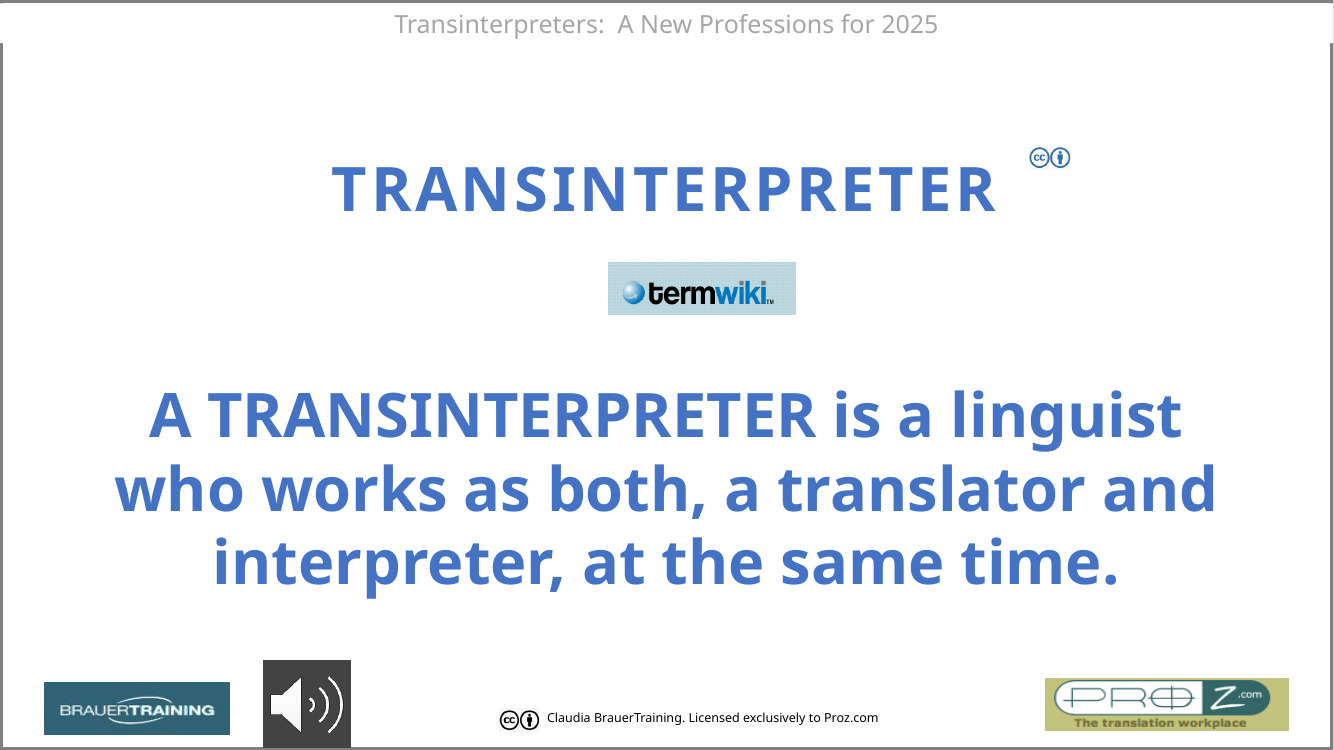
The transinterpreter. A transinterpreter is a linguist who works as both a translator and an interpreter — at the same time, as one integrated professional offer. This is not a translator who occasionally helps out with a phone call. It is a professional trained in both crafts: written translation, consecutive interpreting, and simultaneous interpreting, including the hybrid mode known as sim-consec, and able to deliver in person, over the phone (OPI), by video remote (VRI), and through web-based platforms. Clients increasingly buy outcomes, not categories. The professional who can cover both sides of an assignment is simply more valuable than two half-available specialists — and harder to replace.
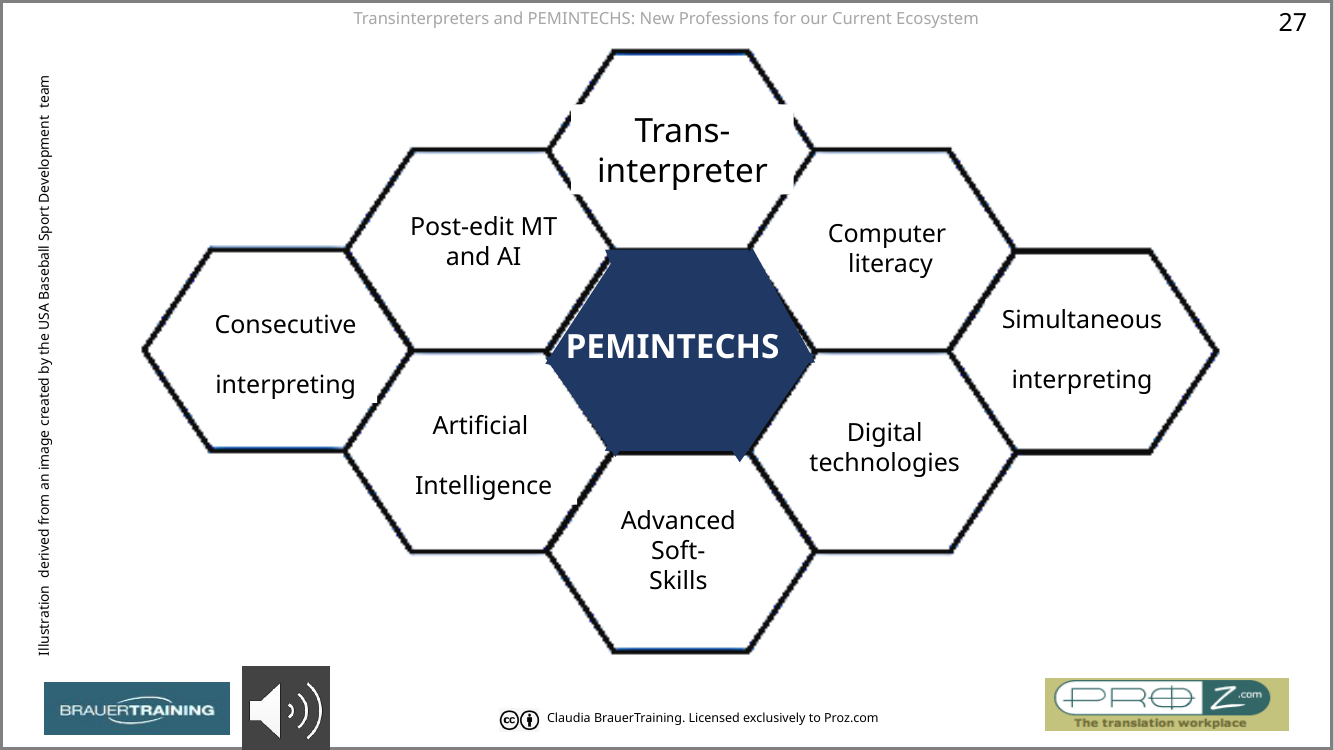
The pemintech. A pemintech is a post-editor of machine and AI translation who is also an interpreter, and who is savvy in the use of technology. Unpack the name: PEM — post-editor of machine translation; INT — interpreter; TECH — technologically fluent. The pemintech’s skill set forms a wheel: post-editing MT and AI output, simultaneous interpreting, consecutive interpreting, transinterpreting, computer literacy, digital technologies, artificial intelligence, and advanced soft skills. This profile exists because of how work actually arrives now: a machine-translated document in the morning, a video meeting to interpret after lunch, terminology to control throughout. One professional, built for that mixture.
Why new professions appear at all. Electricians did not exist before electricity. Professions are born “in response to” radical changes in how humans communicate and work — and machine translation plus remote interpreting is exactly such a change. Transinterpreters and pemintechs are not marketing labels. They are the labor market’s answer to a new technical reality, the same way electricity created the electrician.
What “tech-savvy” concretely means. Not a vague comfort with computers — a checklist. A proficient user of desktop and laptop computers, tablets, and modern phone systems. Fluent in the office suite and in OCR software. At home on the video-remote interpreting platforms clients actually use — KUDO, Interprefy, Voiceboxer, Interactio, Zoom, Microsoft Teams, Boostlingo, and others. A proficient user of CAT tools and translation memories, and of machine translation itself, understanding that engines differ and output varies. Knowledgeable in business software such as accounting and invoicing, and aware of project-management tools. That is the floor, not the ceiling.
And the soft skills are not optional. Technical skill alone is no longer enough. The new profiles require the ability to change gears, emotional intelligence, teamwork, work ethic, and communication skills. The beginner set: problem-solving, critical thinking, passion, curiosity, flexibility, commitment, persistence, creativity, imagination. The advanced set: attention to detail, time management, writing proficiency, media literacy, initiative, leadership, collaboration, productivity, and social skills. Knowledge versus skills is the distinction that matters — knowing about the work is theory; the market pays for people who can do it.
A self-audit: which one are you becoming? Read the two definitions again as a mirror. If you translate well but have never trained in interpreting technique — no consecutive, no simultaneous — the transinterpreter path starts there, with the interpreting half of the craft. If you already move between written and spoken work but machine translation post-editing is your gap, that is the pemintech path, and it starts with post-editing practice and technology. And if technology itself is the weak leg, the checklist above tells you where to begin. The point of the audit is honesty: the market will not wait for any of us to feel ready, but it rewards professionals who close their real gaps instead of polishing their existing strengths.
The wider map — and where to start. The course also maps income honestly. The established sources of income — translator, transcreator, localization expert, interpreter, posteditor — now stand joined by two new lines: transinterpreter and pemintech. The task is to add the new lines deliberately, alongside the work that already pays — not to abandon proven income on a promise.
These two profiles sit inside a much larger family of new language careers: localization expert, transcreator, project manager, research linguist, subtitler, voice actor, terminologist, LQA tester, SEO specialist, content writer, language trainer, language technologist, language consultant, language lead. Underneath all of them runs the shift Nimdzi Insights describes: from translator to trusted advisor, the professional clients call for expertise, cultural insight, and judgment. As translator Valerie Anger recently wrote, the real question is not whether we still need humans, but where human expertise, judgment, and accountability are indispensable. In the course I close with a survival list for the next five years: become tech-savvy, specialize, practice adaptability, grow your emotional intelligence, stay updated, keep learning, provide MTPE, use AI-powered tools, collaborate with AI — and deliver quality, every time. You do not need to learn it all at once. You need to develop skills, one at a time — starting with the profile closest to the work you already do, and then practicing. Practice, practice, practice: that is how a new profession becomes your profession.
My course “New professions for 2025: Transinterpreters and pemintechs,” presented for ProZ, walks through both profiles: the key issues driving the shift, the skill sets each profile requires — interpreting, post-editing, technology, soft skills — and practical tools to prepare your growth plan, so you can adapt to the evolving marketplace deliberately, before the demand peaks, and stay ready for the challenges of a fast-moving world instead of reacting to them. Both professions are within reach of working translators and interpreters today — this course shows the route, step by step.
Take the course: New professions for 2025: Transinterpreters and pemintechs — https://www.proz.com/next/learn/course/354
Sources: Nimdzi Insights, “Translators’ Role Evolves in AI-Driven Localization” — https://lnkd.in/p/eayb-7fY · Lionbridge, “AI Content Creation for Global Retail Giant” — https://lnkd.in/p/eFP5T7GC · Valerie Anger, LinkedIn post — https://lnkd.in/p/eNPySBrN

